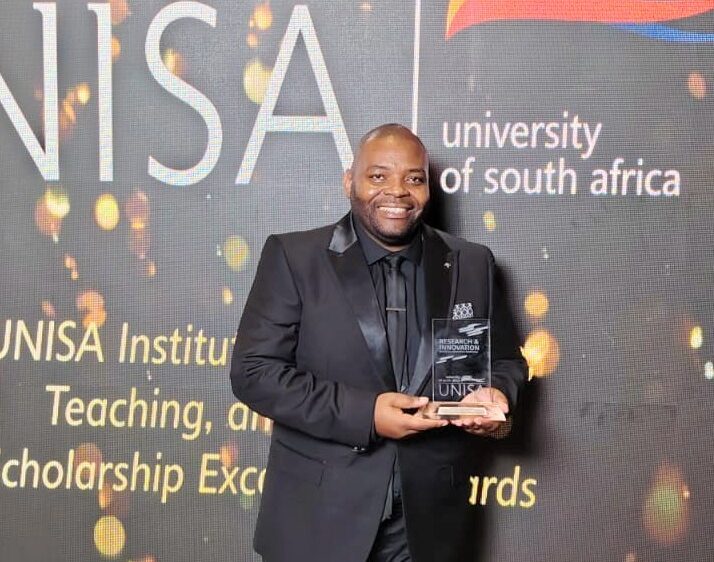
Welcome to AASR Member Spotlight where we celebrate the inspiring works of our members who are carrying out outstanding research. On this edition, we beam the spotlight on Joel Mokhoathi of the University of South Africa. He shares his interesting research and the impact of the Association on his career trajectory.
Briefly tell us about yourself:
My name is Joel Mokhoathi, an Associate Professor and National Research Foundation (NRF) Y2 rated researcher in the Department of Religious Studies and Arabic at the University of South Africa (UNISA). I hold a Doctor of Philosophy (PhD) degree, specializing in Religion Studies, from the University of the Free State (UFS), Bloemfontein, South Africa. My areas of interest are, namely: African Christianity; African Traditional Religion; Indigenous Knowledge Systems and Decoloniality.
What are the recent research projects you are involve in?
I am currently busy with a research project titled “Reawakening the Sacred: Reviving Africana and Diasporic Spirituality”. This is an innovative and multi-disciplinary project that is aimed at revitalizing Africana and diasporic spirituality through cutting-edge academic research, collaborative partnerships, and stakeholder engagements that are rooted in communities of practice. The project centres around the awareness that the colonial and Apartheid eras have systematically suppressed Africana and Diasporic Spiritualities, erasing Indigenous Knowledge Systems and marginalizing communities. It therefore seeks to revive, document, and celebrate these spiritual traditions, creating a global dialogue that unites these communities and preserves their unique identities. The project does this by leveraging on digital humanities’ tools, such as creating accessible, interactive, and research-driven platforms to document, analyse, and disseminate Africana spiritual practices and philosophies. This will potentially be done in partnership with the UNISA Advancing African Digital Humanities Ideation Hub (AADHIH).
In what ways does your research address pressing societal challenges?
As the title suggests, the project intends to “reawaken”, “renew” or “revive” the embodiment of Africana and diasporic spirituality. It denotes the linking and delinking of historical moments in the embodiment of Africana and Diasporic Spirituality, where African expressions of culture and spirituality were hindered by colonialism and/or Apartheid moments. In line with Afrocentricity, this project seeks to preserve, document, and elevate the spiritual traditions, practices, and philosophies of African and diasporic communities, which have historically been marginalized, misrepresented, or erased. By fostering a deeper understanding of these spiritual systems, the project aims to empower communities, promote cultural continuity, and contribute to global heritage.
What roles have AASR played in your professional development?
The African Association for the Study of Religions (AASR) has played a significant role in my academic growth by linking me with prominent scholars in my field of research. I got to meet and interact with leading scholars, who shaped my professional carrier, such as Profs. Afeosemime Adogame, Mary Getui, Jack Odhiambo and many others. It is always a privilege to interact with giants, whose shoulders, we stand on.
Reflecting on your journey so far, what advice would you offer to emerging scholars in your field?
Looking back to my younger self, the advice that I would give is that building bridges is a currency, sometimes, more valuable than money. Knowing and linking with good people create spaces for self-actualisation, whether in terms of personal growth, partnerships or mentorship. That is, even though self-reliance is admirable, collaborations are more potent.
Are there any major challenges you encountered in your career? How did you overcome them?
As a researcher, I often find that funding is a major obstacle in actualising one’s goals. This is the case for research projects, for conference attendances or any other research travel costs. In order to deal with these challenges, I have learnt to be more resourceful, to try to tap into multiple streams of income, and look for alternative grants. This means extra paperwork and taking chances. But the outcomes are also worth it because even in rejection, there is a lesson to be learnt. Having no funding, therefore, should not be the end of our aspirations. Rather, we should try to be resourceful by exploring alternative sources.